
A few weeks ago, we spent several days at Disney World.
Every morning, we woke up early. Every night, we went to bed late. We walked well over ten miles a day. The temperatures hovered in the 90s. The rides were thrilling, the crowds were enormous, and the days were packed from beginning to end.
And do you know how many times Lucy complained?
Zero.
Not once!
She never whined about being tired. She never griped about the heat. She never argued about what ride was next or complained when something didn’t go exactly her way. She was grateful, joyful, flexible, and eager for every adventure.
Richard and I were honestly blown away.
As we watched families around us dealing with tears, meltdowns, complaints, and constant battles, we kept looking at each other and saying, “Can you believe how well she’s doing?”
We were proud—not because she was perfect, but because she was displaying the character traits we’ve spent years intentionally trying to cultivate.
Then we came home.
And suddenly, it felt like a completely different child had moved into our house.
The complaining started.
The groaning over simple responsibilities started.
She lied to me about completing a handwriting assignment.
Her focus disappeared.
Her listening skills disappeared.
Even her respect for authority seemed to be slipping.
Now, to be fair, I know many parents would look at this situation and immediately point to the obvious explanations.
We had just returned from Disney World. Lucy was coming down from days of excitement, adventure, late nights, and constant stimulation. Re-entry into normal life can be hard for anyone, especially a child.
And honestly? Those factors probably did contribute to some of what we were seeing.
But here’s something I believe deeply: explanations are not excuses.
Understanding why a behavior happens is important. Ignoring the behavior because we understand it is not.
I don’t want to become the kind of parent who explains away poor choices simply because I can identify what influenced them. My job isn’t to excuse bad behavior; it’s to help my children learn how to overcome it.
Because one day Lucy will be an adult, and life will still be stressful. She’ll still be tired. She’ll still experience disappointment, frustration, and seasons of transition. The goal isn’t to teach her to behave well only when circumstances are ideal. The goal is to help her develop the character to do what’s right even when they aren’t.
The final straw came when Lucy’s swim instructor at Aqua-Tots told me that she was struggling to listen and pay attention during class.
I was deeply disappointed.
Not because I expect perfection, but because I know Lucy is capable of more.
After some thought and prayer, Richard and I discussed what consequences would be appropriate. We wanted them to be meaningful enough to teach a lesson, not simply create temporary discomfort.
Lucy’s favorite activity in the world is horse lessons.
As a consequence for the lying, the poor attitude, and the pattern of not listening, she would miss her next two horse lessons.
But there was more.
She would also need to call her horse instructor herself and explain why she would not be attending.
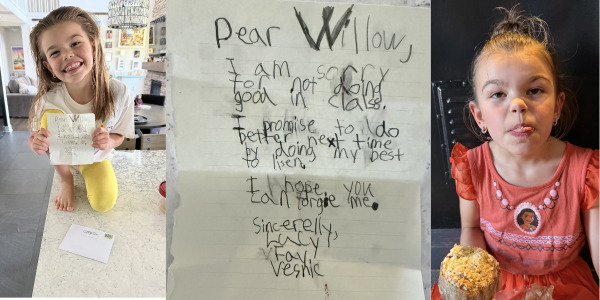
And she would write an apology letter to her swim instructor for not listening during class.
Before making the call, I contacted her horse instructor, Taylor, and explained the situation. I didn’t want Lucy calling unexpectedly. Taylor was incredibly gracious and immediately supportive.
When it came time for Lucy to make the call, she was devastated.
The tears flowed.
She wanted nothing to do with it.
So before she picked up the phone, I sat with her.
I hugged her.
I reminded her that I loved her.
I told her I was proud of her for being willing to do something hard.
I explained that I wasn’t punishing her because I was angry. I was correcting her because I love her.
I even shared something personal.
I told her that nobody corrected me this way when I was young. As a result, some of the lessons about humility, accountability, and ownership didn’t come until I was much older—when the consequences were far more painful and heartbreaking.
I told her that learning these lessons now was a gift, even though it didn’t feel like one.
Then she made the call.
Through tears, Lucy explained to Taylor why she wouldn’t be attending her next two lessons.
Taylor responded beautifully.
She told Lucy that she loved her, that she would miss her, that the horses would miss her, and that she was looking forward to seeing her again. She also gently reminded Lucy that listening to her mom is important.
Later, Lucy wrote an apology letter to her swim instructor, Willow. We addressed the envelope, added a stamp, and mailed it.
None of this was fun.
Not for Lucy.
And honestly, not for me either.
Parenting this way is hard.
It would have been much easier to simply say, “Knock it off and do better next time.”
But deep down, I knew that wouldn’t teach the lesson that needed to be learned.
Sometimes loving our children means doing the uncomfortable work.
Sometimes it means allowing them to feel the weight of their choices.
Sometimes it means choosing long-term character development over short-term comfort.
In a world where many parenting philosophies prioritize protecting children from difficult feelings, I believe some feelings are worth experiencing.
Regret.
Conviction.
Accountability.
Humility.
Not because I want my children to suffer, but because those feelings often become the doorway to growth.
The beautiful thing is that Lucy understood exactly why these consequences existed.
She understood that she wasn’t a bad kid.
She understood that she is deeply loved.
She also understood that the path she had been choosing wasn’t leading her toward the kind of person she wants to be.
And that matters.
Because the Disney World version of Lucy didn’t appear by accident.
That joyful, grateful, resilient little girl was built through thousands of moments of correction, guidance, encouragement, accountability, and love.
Character doesn’t magically show up when life gets hard.
It is developed long before the hard moment arrives.
So on days like this—days when parenting feels heavy and uncomfortable—I remind myself to stay the course.
Because I’ve seen who Lucy can be.
I’ve seen the girl who walks ten miles in the Florida heat with a smile on her face.
I’ve seen the girl who thanks God for every adventure.
I’ve seen the girl who notices the needs of others.
I’ve seen the girl who chooses joy.
That is who God created her to be.
And my job isn’t simply to enjoy that version of her when she appears.
My job is to help her become that version of herself more and more often.
Even when the lessons required to get there are hard for both of us.